
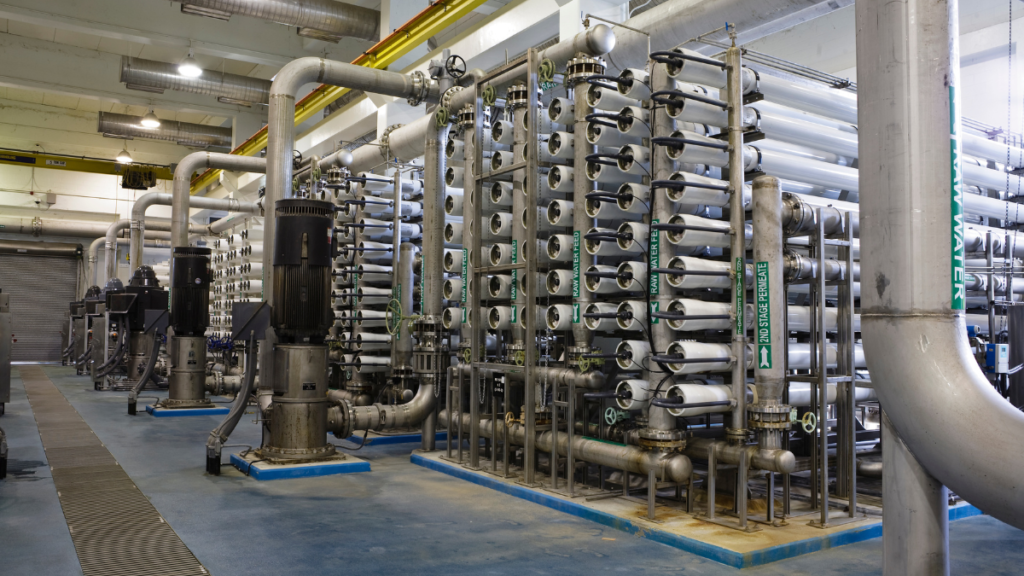
Tens of thousands of FRP pressure vessels are used in reverse osmosis (RO) desalination facilities that supply potable water in arid regions all over the world, particularly in the Middle East and Australia.
Operating at high pressures and in corrosive environments, RO systems present unique maintenance and reliability challenges. Many have been operating for over 30 years and may be reaching the end of their service life.
However, while design codes cover how RO vessels must be manufactured, prior to now there has been little guidance available for determining their Fitness For Service.
The American Membrane Technology Association (AMTA) has addressed that issue with the new “Guideline for Membrane System Safety and Reliability,” which was released in early 2026.
It’s the result of work by a project team led by Doug Eisberg and Sean McCagh that included UTComp founder and CTO Geoff Clarkson.
The guideline is a major step forward in helping the industry reduce risk and avoid potentially catastrophic failures, protect personnel and extend the life of RO assets with informed maintenance planning and decision making.
Get the new AMTA guideline here.
RO membrane vessel research contributed to guideline
Developers of the AMTA guideline drew upon previous research by UTComp and UltraAnalytix® licensee RPC Technologies Pty (RPC).
The companies conducted laboratory-scale testing of FRP composite RO pressure vessels used in municipal and industrial water desalination plants. They used UltraAnalytix® NDE to assess the condition and performance of the vessels while filled and under pressure, and to understand the conditions that may lead to loss of containment.
Key findings
In RO pressure vessels, leaks are most likely to start as a brittle fracture of the laminate in high-stress areas such as the access ports as well as the end plate. While FRP is highly resistant to saltwater corrosion, mechanical stress will eventually degrade the resin to the point that leaks will occur.
Key project outcomes included:
- The UltraAnalytix system can be used to calculate the remaining service life (RSL) of RO pressure vessels.
- The researchers were able to assess the quality of laminate.
- A systematic approach was developed for early detection of any polymer deterioration.
- Conditions leading to vessel failure are now better understood and predictable.
- UltraAnalytix data results were validated by destructive testing.
- The team identified the most efficient locations for data collection: two small sections about 75 mm in length, located between the vessel access ports and end caps.
That project demonstrated the value of UltraAnalytix in providing a fast, reliable, and cost-effective method for determining the Fitness For Service of RO pressure vessels.
Regular inspections using the UltraAnalytix system could save the global desalination industry billions of dollars by reducing losses of a valuable resource (water) through leaks and other failures, improving reliability, increasing operational uptime and lowering capital replacement costs.
Learn more by reading the case study.